Podcast: Play in new window | Download
Subscribe: Apple Podcasts | Spotify | RSS
FEATURE INTERVIEWS:
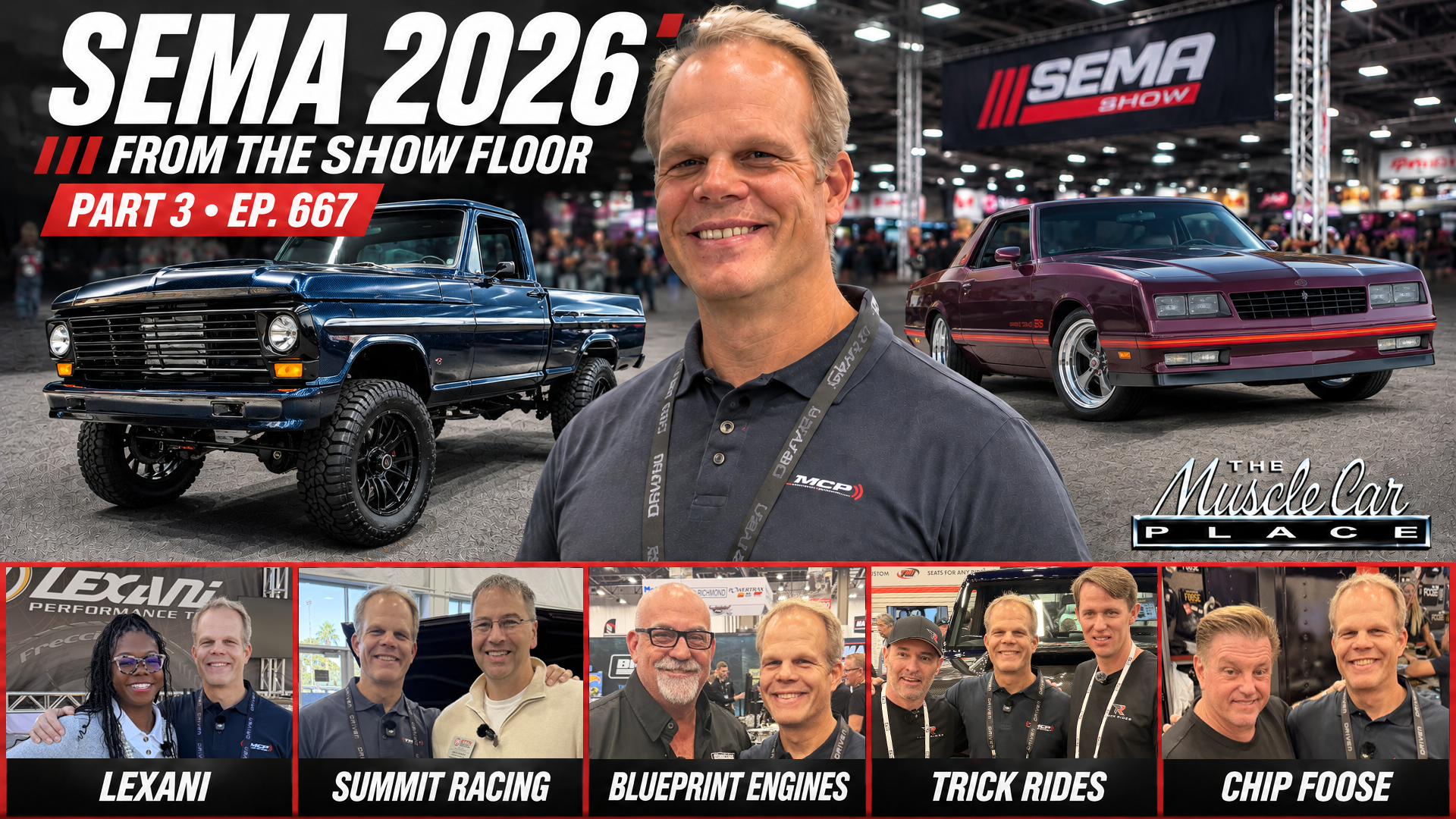
SEMA SHOW SPECIAL 2026 – Part 3, The Finale
A worn-out Monte Carlo goes from a carbureted 305 to more than twice the power and a much cleaner tailpipe. A traditional 383 small-block gets a modern eight-speed. A carbon fiber Ford pickup has a carbon fiber bed floor. And Chip Foose designs a Corvette chassis around one detail he wants to get right from the beginning: the depth of the wheel.
For TMCP #667, Rob Kibbe closes out our three-part SEMA 2026 series with Bridney Jordan of Turbo Tires, Greg Banish of Calibrated Success, Jason Bruce of BluePrint Engines, Jason Engel and Jarred Morris of Trick Rides, and Chip Foose of Foose Design. You’ll hear why RBP is bringing back its wheels, what Summit learned from testing its Monte Carlo one change at a time, and why BluePrint’s customers still want a traditional small-block. We also get a first look at what Trick Rides wants to bring to SEMA next year and find out what Rob enjoyed most about watching Overhaulin’.
Listen to the complete episode above, then watch the individual interviews below for a closer look at the builds and products.
Lexani, Lionhart, & RBP Tires
RBP Wheels Are Back, and a Jeep Named Grace Gets a Set of Tires
Rob spots a Cadillac on 20-inch Lexanis and brings a familiar question to Bridney Jordan: Once you’ve picked a wheel for your muscle car, who actually makes a tire in the size you need? Bridney points to Lionhart’s all-season lineup and recalls walking through the classic vehicle section of a Texas show and seeing Lionharts on C10s and other builds. Lionhart recently added all-terrain, highway-terrain, and all-season offerings, while RBP is putting its attention toward new tread designs and larger flotation sizes for trucks.
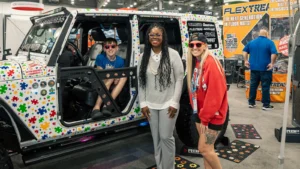
The conversation turns to Grace, the Jeep JK that FlexTread and Legendary Auto Interiors brought to SEMA for their autism awareness campaign. When Bridney heard about Winter, his mom Bri, and how much Winter enjoys cars, RBP offered to put a set of tires on the Jeep. It’s a personal moment in an interview that also marks a first for The MuscleCar Place. Rob tells Bridney that Turbo Tires is the first tire manufacturer to partner directly with the show.
Just when Rob is ready to wrap up, Bridney has one more announcement: RBP Wheels are coming back. She explains that the wheel business had operated separately and that Turbo Tires acquired the rights and brought in a distribution partner. Forged wheels are slated to lead the return, with the first offerings expected around Christmas 2026 when we spoke at the show. That puts RBP wheels and tires under the same roof heading into 2027.
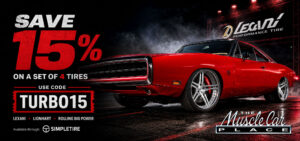
Save 15% on four tires. Use code TURBO15 at SimpleTire through December 1, 2026, on a qualifying purchase of four tires. Bridney confirms that eligible tires from participating brands can be mixed in the same order. Shop SimpleTire
Explore Lexani Tires, Lionhart Tires, RBP Tires, and Grace’s autism awareness campaign, then watch the full interview below.
Summit Racing and Calibrated Success
Can an ’87 Monte Carlo Make Twice the Power with Half the Emissions?
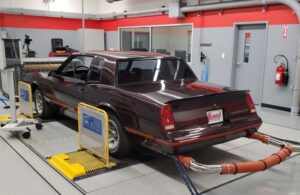
Summit Racing asked former GM and Ford calibration engineer Greg Banish a question that sounds simple until you have to prove it: Could you take an older car, double its power, and cut its emissions in half? For Project Prodi-G, Summit chose a 1987 Monte Carlo SS with 97,000 miles, a 305 with an electronically controlled carburetor, and a pellet-style catalytic converter. The team tested the car as it arrived, then tracked horsepower on a chassis dyno and emissions at the SEMA Garage laboratory as the build progressed.
The first round looked a lot like what someone might do in their own garage: an intake, headers, exhaust changes, and eventually an aftermarket EFI conversion. Then the team installed a BluePrint Engines 383 using the same EFI system. It doubled the baseline power and improved emissions. A teardown of the original 305 gave the team a closer look at what they had started with: a cracked block and plenty of sludge.
Next came a naturally aspirated 5.3-liter LS that made about 400 horsepower on Trick Flow’s engine dyno. Greg explains what he gained by going to sequential multiport injection with a GM controller like the one used in a 2001 Camaro. The team also tested different catalytic converters and header configurations. On this combination, mid-length headers gave them the best results for both power and emissions.
The final tally was 2.3 times the power and roughly 90% lower emissions compared with the Monte Carlo as purchased. Greg and Rob discuss what those measured results can tell builders and how formal approval for modified vehicles is a separate process. The car still runs its 200-4R, which leaves Greg thinking about what he could learn from a modern automatic, boost, or a newer direct-injection engine.
Learn more at Summit Racing and Calibrated Success, then watch the full interview below.
BluePrint Engines
A 436-Horsepower 383 Meets a ZF Eight-Speed
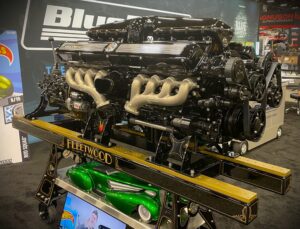
BluePrint started putting ZF eight-speeds behind its LS engines, and customers came back with a question: When can we get one behind a traditional small-block Chevy? At SEMA, Jason Bruce shows Rob the answer in the form of a Builder Series 383 stroker making 436 horsepower and 443 lb-ft of torque, paired with a ZF 8HP automatic. Jason explains how BluePrint and ZF calibrated the engine’s self-learning multiport EFI and the electronic transmission to work together, including getting the shift behavior right.
It’s easy to assume the popularity of LS swaps would eat into traditional small-block sales. Jason says BluePrint set a small-block Chevy sales record the previous year. For plenty of Camaro, Chevelle, and C10 owners, a small-block still looks right under the hood. The eight-speed package gives those builders a way to keep the engine they want and change how the car drives.
Jason also takes us from Norris Marshall’s one-man machine shop to the Kearney, Nebraska, operation that he says builds 80 to 100 engines a day. The final quality check includes a dyno test for every long block and higher-level package. The team checks the oil, cuts open the filter to look for debris, and sends the customer the results from that engine’s own dyno pull. Jason also explains why a shortage led BluePrint to start selling bare blocks and discusses its reported 2027 NHRA block approval and ongoing talks about circle track applications.
Two displays round out the visit. Brian Fuller put two V8s together with a manual transmission for a Hot Wheels-inspired project. Fat Fender Garage took a Builder Series 376 in a different direction with manifold changes, custom badging, and a Cerakote finish. If you’ve ever looked at a crate engine and started thinking about what you’d change before it went in your car, there’s plenty to see here.
Explore BluePrint Engines, then watch the full interview below.
Trick Rides
A Carbon Fiber F-100 4×4, Right Down to the Bed Floor
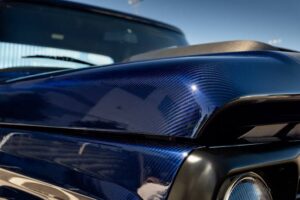
Jason Engel and Jarred Morris had already worked on carbon fiber Camaros and Mustangs. For their first four-wheel-drive truck together, they chose a 1968 Ford F-100 and went further with carbon than you might expect. On “Tricky,” the hood, fenders, bumpers, bed, and even the bed floor are carbon fiber. The factory steel remains in the cab floor, firewall, and inner structure. The panels come from Brothers Carbon in Wisconsin, and one of Rob’s favorite details is the weave showing through the dark blue paint.
Underneath is a Roadster Shop chassis, with a Whipple-supercharged Coyote and ten-speed automatic in the four-wheel-drive truck. Jason and Jarred also discuss a slammed two-wheel-drive version and what customers can choose when they order one. The conversation gets into how their family-run Oklahoma shop works. They’ve developed a process they can repeat from truck to truck, and they’re willing to redo a detail before delivery even when the customer would never know.
Then Rob asks what’s next. The answer is a one-off carbon fiber 1968 Dodge Charger with a Roadster Shop FAST TRACK chassis, custom floors and interior, a 900-horsepower Whipple-supercharged BluePrint engine, and a six-speed. The Charger already has an owner, and Jason and Jarred hope to debut it at SEMA 2027. After seeing the fit and finish on the F-100, Rob is ready to see what they do when they build a Charger for one customer from the start.
See the full specs for Tricky, the carbon fiber ’68 F-100, then watch the full interview below.
Chip Foose
The Corvette Chassis That Started with a Deep-Dish Wheel
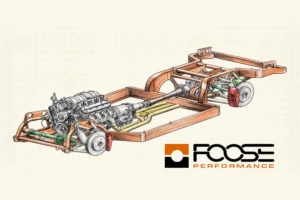
Chip Foose wanted a larger-diameter wheel that still looked at home on a classic Corvette. To get the deep dish he was after, he set the track width first and designed the suspension around it. The result is the new Foose Performance rolling chassis for 1963–82 Corvettes, developed with MagnaFlow. Chip walks Rob through the C7-inspired suspension geometry, the shorter control-arm option for a deeper dish, and the bumper bracket changes that let the design cover both C2 and C3 Corvettes.
Chip already has designs in the computer for a 1953–56 Ford F-100 and a 1955–57 Chevrolet that use the same suspension concept on different frames. He’d also like to tackle Impalas and talks through how a Camaro front subframe and rear suspension package might work. Then he explains MagnaFlow’s role in manufacturing and selling the chassis and what buyers can expect from the production frame’s finish.
There’s more at the booth, including a new Foose car care line and the Mustang and Rumble Bee projects with FOX Factory Vehicles. The interview ends on something simpler. Rob tells Chip that his favorite part of Overhaulin’ was watching him sketch and compares it to watching Bob Ross. Chip says he still draws almost every day. After hearing how a wheel’s proportions set the direction for an entire chassis, you can see why Rob wanted to ask.
Visit Foose Design, Foose Performance, MagnaFlow, and FOX Factory Vehicles, then watch the full interview below.
Thanks for coming along for all three parts of our SEMA 2026 coverage.
If you missed the first two installments, catch up with TMCP #665 and #666 at The MuscleCar Place.
Save 15% on Your Next Set of Tires
Need tires for your muscle car, truck or daily driver? Save 15% on a set of four participating Lexani, Lionhart or RBP tires through SimpleTire by using promo code TURBO15 at checkout. It’s an easy way to shop for the tires you need online and have them shipped directly to your home or a nearby installer.
This interview sponsored by our pals at National Parts Depot – your premier source for muscle car restoration parts!